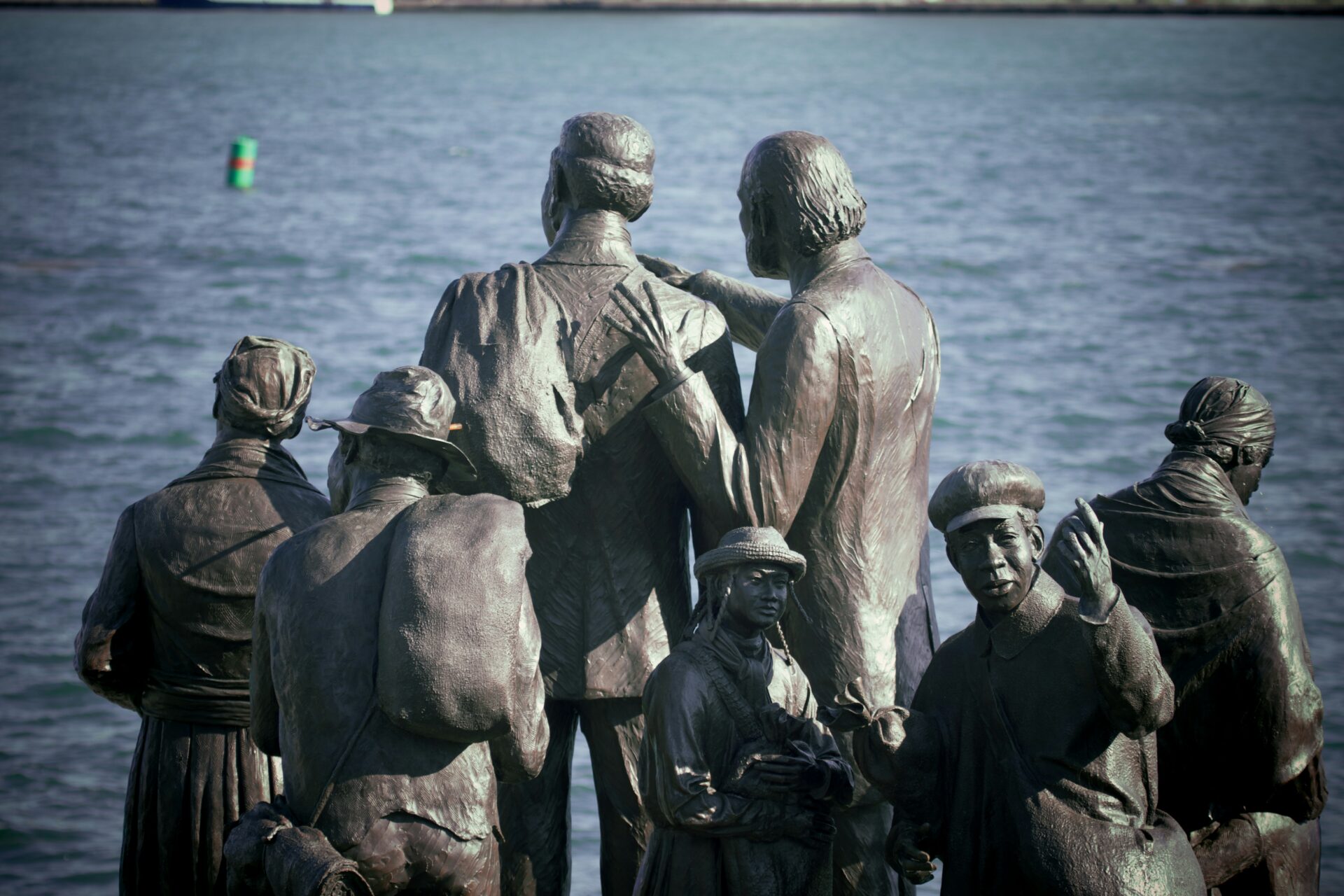
Courtesy: Destiny Photography, by permission from Upsplash
POESIS: Power, Knowledge, and Servitude at Sea
A cross-institutional BCDSS–IDOS Research Group (2026–2033)
POESIS approaches the sea not as a passive backdrop but as an archive in motion: a generative site of political and epistemic struggle that illuminates wider relations of asymmetric dependency and attachment beyond the maritime itself. Drawing on decolonial feminist, southern, pluriversal, and more-than-human thought, we investigate how forms of servitude persist across interconnected hydrosocial worlds, rooted in the legacies of imperialism, slavery, and developmentalist dispossession.
Our focus is on the forms of labour, knowledge, and ecological life that are drawn into conventional projects of sustainability, heritage-making, custodianship, and post-extractivist repair. We ask how such projects often depend on human and more-than-human worlds that are structurally subordinated and rendered extractable/erasable, even as they continue to sustain socioecological life under conditions of ongoing dispossession.
Why saltwater worlds?
The ocean is one of the starkest sites of global inequality, where extraction, violence, and erasure are acutely lived. Yet the relations of power and asymmetric dependency that govern the sea remain strikingly undertheorised, persistently displaced by land-based frameworks. POESIS addresses this gap by examining how imperial, racialised, gendered, and interspecies hierarchies are reproduced, negotiated, and contested across maritime infrastructures, coastal archives, shipping routes, urban redevelopment, and projects of ecological restoration and restitution.
While POESIS begins from saltwater worlds as a key analytic site, it refuses any rigid distinction between marine and freshwater environments. We do not treat sea, land, and riverine worlds as separate domains, but as connected terraqueous spaces shaped by interspecies histories and hydrosocial relations that exceed the sea as a bounded object.
Our Core Questions
(i) How do particular ways of knowing, labouring, and relating to more-than-human worlds become indispensable to projects of development, sustainability, and environmental repair, while remaining marginalised within the very structures they sustain?
(ii) How are these dependencies lived, interpreted, and contested by those who are shaped by them?
Photo credits: Nilantha Ilangamuwa
How we work
Our work is organised around two core concepts. Epistemic dependency examines how authority is constituted through unequal relations of recognition, extraction, and reliance: whose knowledge and labour become indispensable, under what conditions, and at what cost. Ecological servitude investigates how the natural world is increasingly enrolled as functional, restorative, and even salvific labouring infrastructure within regimes of sustainability, repair, and environmental governance.
These concepts animate four interlinked research areas: epistemic-extractive, submerged, and disposable relations of historically-informed strong asymmetric dependencies. Across all three thematic areas, we draw together ethnographic, historical, and artistic methods to trace both the concealed dynamics and the hyper-visible struggles that shape oceanic and littoral worlds. The varied themes we engage with include heritage governance below the waterline, securitised conservation, post-extractivist repair and carework often under precarious conditions, dark sites and the spectral afterlives of containing shipping.
Funding
This project is generously funded from 2026 to 2033 by the University of Bonn’s Excellence Cluster Bonn Center for Dependency and Slavery Studies (BCDSS) and is hosted at the German Institute of Development and Sustainability (IDOS) through its partnership programme.